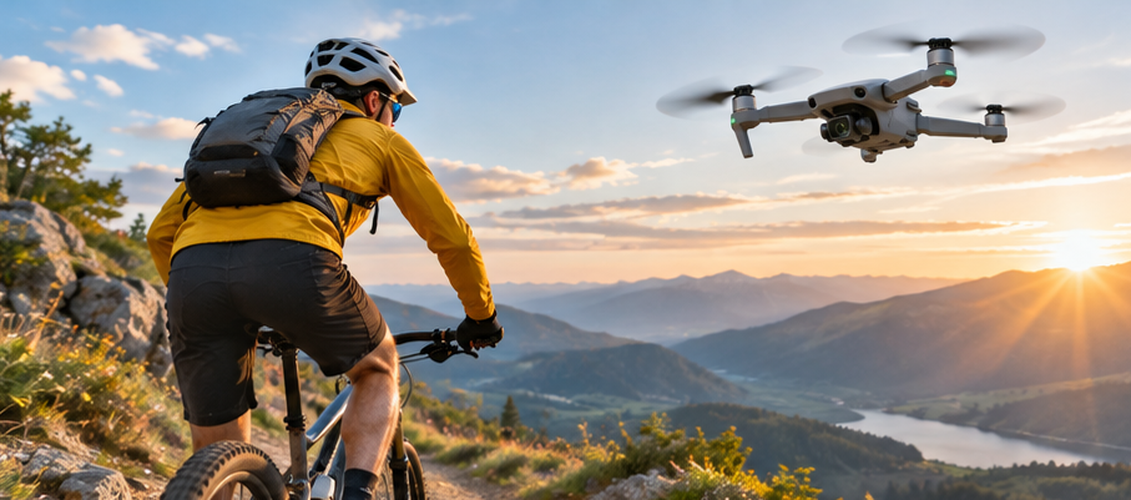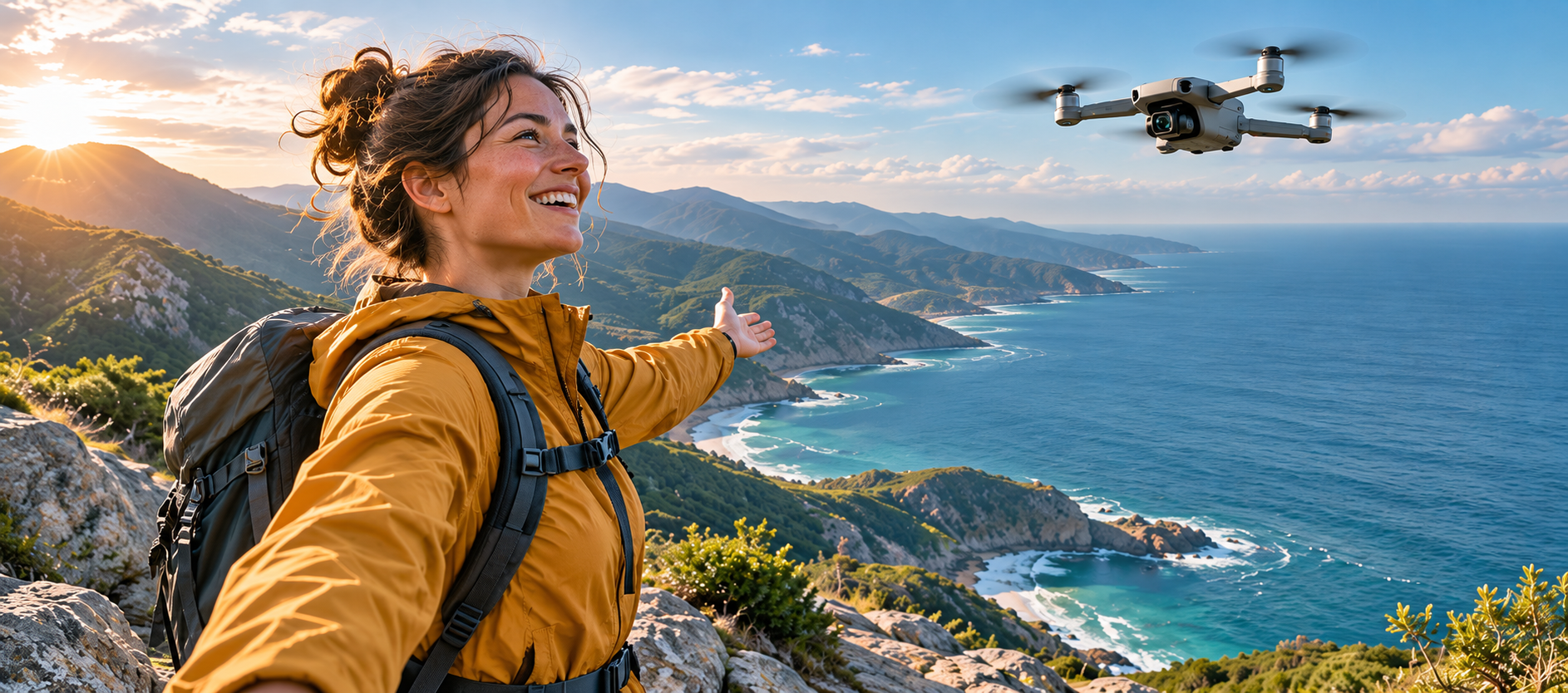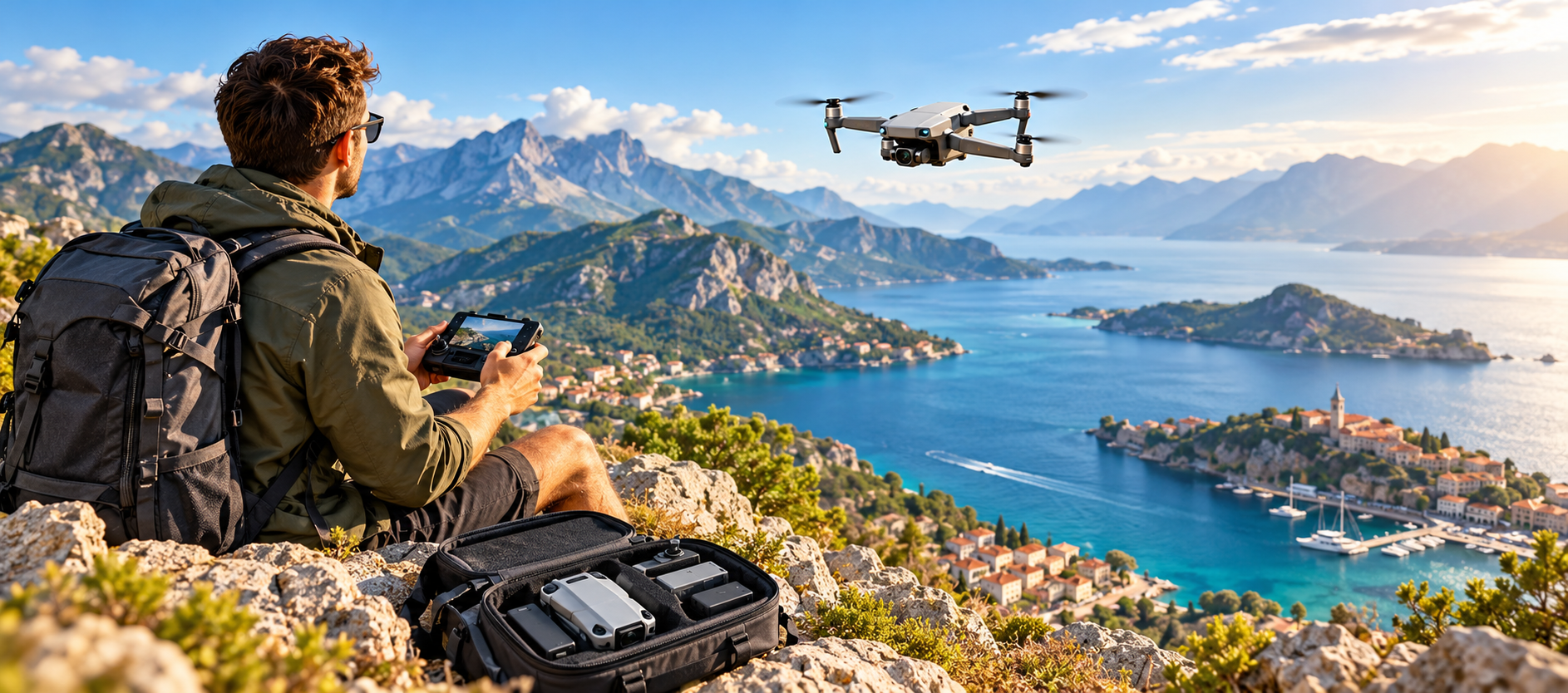
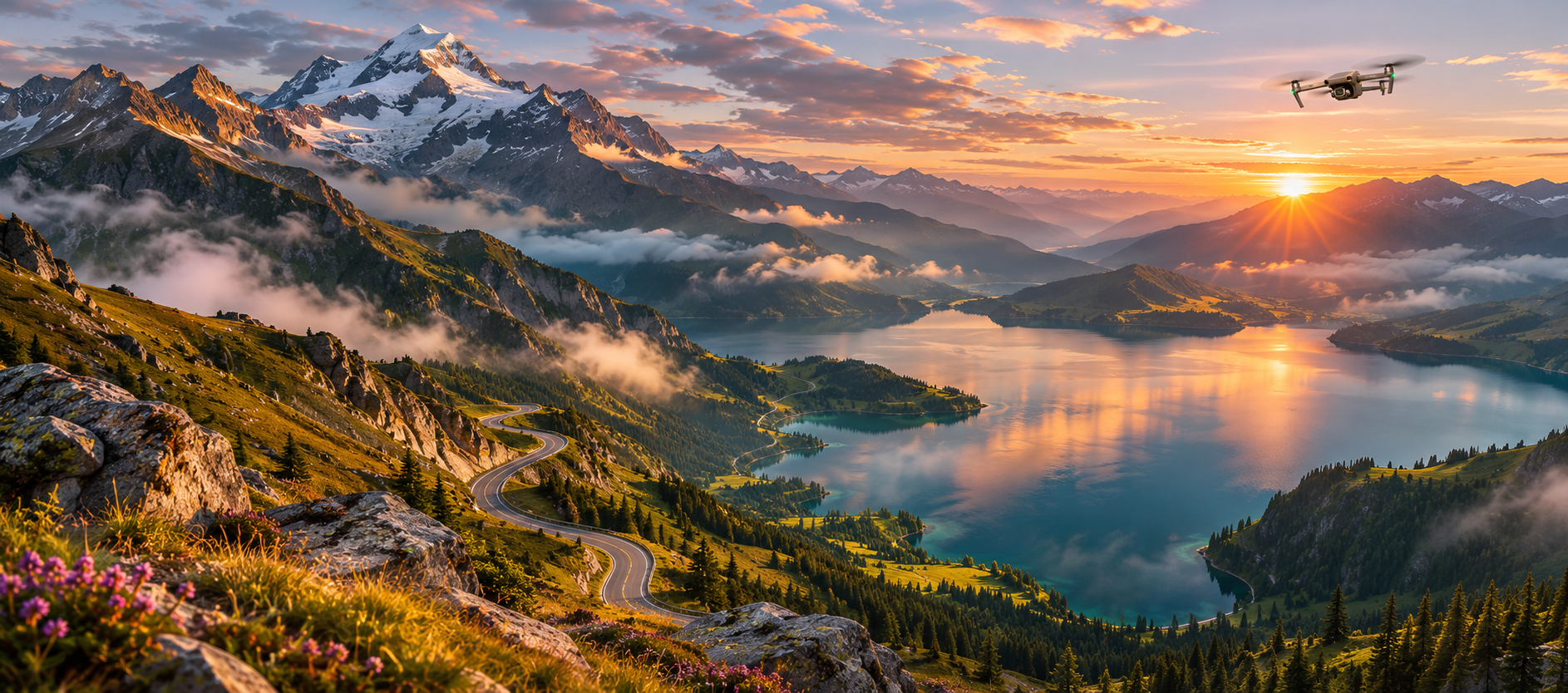
If you’re asking, “Which drone is best for shooting landscapes outdoors?” or “What is the best drone for aerial photography while traveling?”, a compact camera drone that balances image quality with packability is the most practical starting point for most travelers. Prioritize a capable sensor, RAW photo capture, exposure bracketing, a sharp lens, and dependable stabilization. This combination helps capture detailed outdoor scenery without making the travel kit difficult to carry. Choose a larger-sensor system for demanding stills, a multi-camera drone for optical focal-length flexibility, or a 360-degree system when flexible reframing is central to your travel stories.
Coastlines, mountain ridges, and winding roads can look very different from above. A useful travel drone needs to capture detail in bright skies and shaded terrain, stay manageable to carry, and operate reliably in the conditions where flights are permitted.
When searching for the best drone for landscape photography, compare sensor and lens performance, RAW and AEB support, stabilization, total kit weight, battery logistics, and destination rules rather than focusing on headline megapixel figures. The categories below highlight trade-offs rather than ranking individual models; specifications can vary significantly between aircraft and camera modules.
Four Drone Types Worth Considering
Best Overall: Compact Camera Drone
Best for: Hikes, city breaks, viewpoints, and travelers who move between locations.
A foldable camera drone with a capable sensor can balance image quality, controls, and packability. This category is usually the easiest to carry and deploy, but a single camera may limit optical reach. Look for clean RAW files, useful exposure controls, and a lens that stays sharp across the frame; a larger sensor is helpful, but sensor size alone does not guarantee better results.
• Prioritize RAW (DNG), automatic exposure bracketing (AEB), and a three-axis mechanical gimbal where available.
• Compare total carried weight—including the controller, batteries, charger, cables, and case—and check whether the aircraft fits comfortably in your daypack.
Best for Detail: Large-Sensor Photography Drone
Best for: Large prints, detailed portfolios, high-contrast landscapes, and photographers willing to carry a larger kit.
A larger-sensor photography drone can provide more tonal flexibility and cleaner files in low light, especially when paired with a high-quality lens. The gains depend on sensor generation, lens aperture, image processing, and exposure technique; a bigger sensor does not automatically mean a sharper image.
• Check native dynamic range, manual ISO and shutter control, RAW output, and AEB.
• Inspect edge sharpness, distortion, flare, and color consistency across exposures.
Best for Distant Scenery: Multi-Camera Drone
Best for: Layered ridgelines, distant peaks, coastlines, and scenes that need several framing options.
A wide camera can establish the full scene, while an optical telephoto camera can isolate distant features and compress layers. Multiple cameras reduce the need to crop aggressively, but their image quality may differ. Check the actual optical focal lengths and compare sensor size, aperture, RAW support, and color matching for each camera.
• Confirm that the longer view is optical rather than digital zoom, and check whether RAW and AEB are available on that camera.
Best for Creative Travel: 360-Degree Capture Drone
Best for: Immersive travel stories, unusual viewpoints, and creators who want to choose framing after capture.
A 360-degree imaging system records the surrounding view and lets the creator choose the direction and crop later. This can be useful when a scene contains several points of interest, but reframing uses only part of the captured image and may reduce final resolution. Evaluate still-image quality—not just video specifications—before relying on it for prints.
• Check native photo resolution, exported resolution at your intended aspect ratio, detail after reframing, and the editing workflow.
• Verify RAW availability and low-light quality separately; strong video stabilization does not guarantee print-ready stills.
Quick Comparison
Use this category-level table to narrow your options. Treat each entry as a starting point: sensor, lens, and feature support vary by model and sometimes by camera on the same aircraft.
| Priority | Compact camera | Large-sensor | Multi-camera | 360-degree |
| Best use | Everyday trips | Detailed prints | Distant subjects | Flexible framing |
| Lens flexibility | Usually one lens | Usually one lens | Multiple optical views | Reframe after capture |
| RAW / AEB | Verify both | Prioritize both | Verify per camera | Verify stills |
| Low light | Sensor/lens dependent | Strong potential | Varies by camera | System dependent |
| Portability | Usually strongest | Often bulkier | Kit dependent | System dependent |
| Main trade-off | Limited optical reach | Cost and weight | More complexity | Reframed stills may lose detail |
Camera Features That Matter Most

Sensor Size and Dynamic Range
Landscape scenes often contain extreme contrast: sunlit clouds above shaded cliffs, bright snow beside dark evergreens, or glowing water under a sunset sky. Dynamic range describes how much detail a camera can retain in bright highlights and dark shadows. Good highlight retention and clean shadow recovery matter more than a high resolution figure alone. Compare sensor size and generation, lens aperture, and real-world sample images because these factors work together.
RAW Files and Exposure Bracketing
RAW files preserve more capture data for later exposure, white-balance, and color adjustments. JPEG is processed in-camera and is convenient for immediate sharing, but it generally leaves less editing latitude. If the aircraft supports both, recording RAW and JPEG gives travelers flexibility without forcing every image through an editing workflow.
Automatic exposure bracketing captures several frames at different brightness levels, which can help blend high-contrast scenes such as a sunrise behind a mountain. Use AEB when the aircraft can hover steadily and the scene is relatively still; moving clouds, waves, trees, or wind can create alignment problems and ghosting. RAW and AEB complement each other but do not replace correct exposure or careful editing.
Low-Light Image Quality
Golden hour and blue hour produce attractive colors, but limited light increases the risk of noise and blur. A larger sensor and a relatively bright lens can help, while higher ISO increases noise. A gimbal reduces camera movement, but it cannot freeze moving subjects or eliminate blur caused by gusts or very long exposures. Do not assume a stabilized drone can make every low-light shutter speed practical.

For sharper results, start with a conservative ISO, inspect sample images at full resolution, and avoid very long exposures in gusty air. Plan the shot while enough daylight remains; do not launch in unsafe wind or poor visibility just to capture a sunset.
Lens Quality and Focal Length
A wide-angle camera is practical for lakes, sweeping valleys, and top-down patterns. A telephoto camera helps isolate a distant peak or compress successive ridgelines. Compare genuine optical focal lengths, preferably in 35mm-equivalent terms, and examine edge sharpness, distortion, and flare. Digital zoom enlarges or crops the image; it does not add the detail of an optical lens.
Stabilization and Flight Reliability
A three-axis mechanical gimbal helps maintain camera alignment as the aircraft moves. Some 360-degree systems rely more heavily on electronic stabilization, so assess their still-photo output separately. Reliable hovering, intuitive controls, and sufficient battery reserves matter in mountain passes and windy coastal areas. Published maximum flight times are measured under specified conditions; cold weather, headwinds, repeated maneuvers, and aging batteries can shorten usable time. Keep a return-and-landing reserve rather than planning around the advertised maximum.
Which Type Should You Choose?
Choose according to the photographs you want to bring home and the kit you are willing to carry, not the longest feature list.
• For hiking and frequent flights: start with a compact, foldable camera drone that supports RAW.
• For large prints and demanding edits: favor dynamic range, consistent optics, and manual controls.
• For mountains and distant details: consider genuine optical wide and telephoto camera options.
• For immersive travel stories: evaluate 360-degree capture and the usable resolution of exported frames.
Field Tips for Stronger Landscape Photos
• Shoot near sunrise or sunset. Low-angle light adds texture to ridges and cliffs, but check wind, visibility, and local flight restrictions before takeoff.
• Watch the histogram. Protect important highlights in clouds, snow, and reflective water; use RAW or AEB when the scene has extreme contrast.
• Build a clear composition. Rivers, roads, shorelines, and field boundaries create leading lines, but every strong image still needs a clear point of interest.
• Avoid excessive cropping. Reposition only when it is safe and legal, or use an optical telephoto camera when you need a tighter view.
• Plan the route and landing site first. A short shot list, a return path, and a battery reserve help prevent rushed decisions in unfamiliar terrain.
Travel Planning and Flight Rules
Plan for the complete kit: aircraft, controller, batteries, charger, protective case, memory cards, and a way to back up files. RAW images need more storage, so estimate capacity before departure. Check the airline’s current rules for spare lithium batteries and charging equipment, as requirements can vary by carrier and route.

Verify the rules for the exact destination before flying. Check the relevant aviation authority for registration, pilot qualifications, remote-identification requirements, airspace restrictions, and any local permits. Airspace permission does not necessarily allow takeoff from a park, protected reserve, or private property; site access and launch permission may be separate. In the United States, consult current FAA recreational-flight and Remote ID guidance. Avoid wildlife, crowds, restricted sites, and unsuitable weather.
Final Verdict
For most travelers, a compact camera drone with a capable sensor, RAW capture, a sharp lens, and dependable stabilization offers the best balance of image quality and portability. Choose a larger-sensor system when editing latitude and print quality justify the extra size and cost, a multi-camera drone when optical framing options matter, or a 360-degree system when reframing is central to the story. Before departure, verify local rules, launch permissions, weather, and battery transport requirements.
FAQ
Is a larger sensor more important than megapixels?
Often, yes in challenging light: sensor size and generation influence noise and tonal flexibility, while megapixels mainly affect fine detail and how far you can crop. Lens quality and image processing also matter, so compare complete camera systems rather than relying on one specification.
Should landscape photos be shot in RAW or JPEG?
Use RAW when you expect to adjust highlights, shadows, or color; JPEG is convenient for quick sharing. If available, capturing both RAW and JPEG offers editing flexibility and an immediately shareable file.
Can a 360-degree drone replace a traditional camera drone?
A 360-degree system can add framing freedom for immersive travel content, but it may not replace a dedicated still-photo camera for detailed landscapes or large prints. Compare native capture resolution, usable exported resolution after reframing, low-light performance, and RAW support before deciding.